

QUICK ANSWER
A homeowner’s guide to planning custom stained glass for entry doors, bathrooms, stairways, transoms and feature windows.
This resource is written for property owners, church committees and managers preparing for stained glass repair, restoration or preservation conversations. It is educational and does not replace a project-specific assessment.
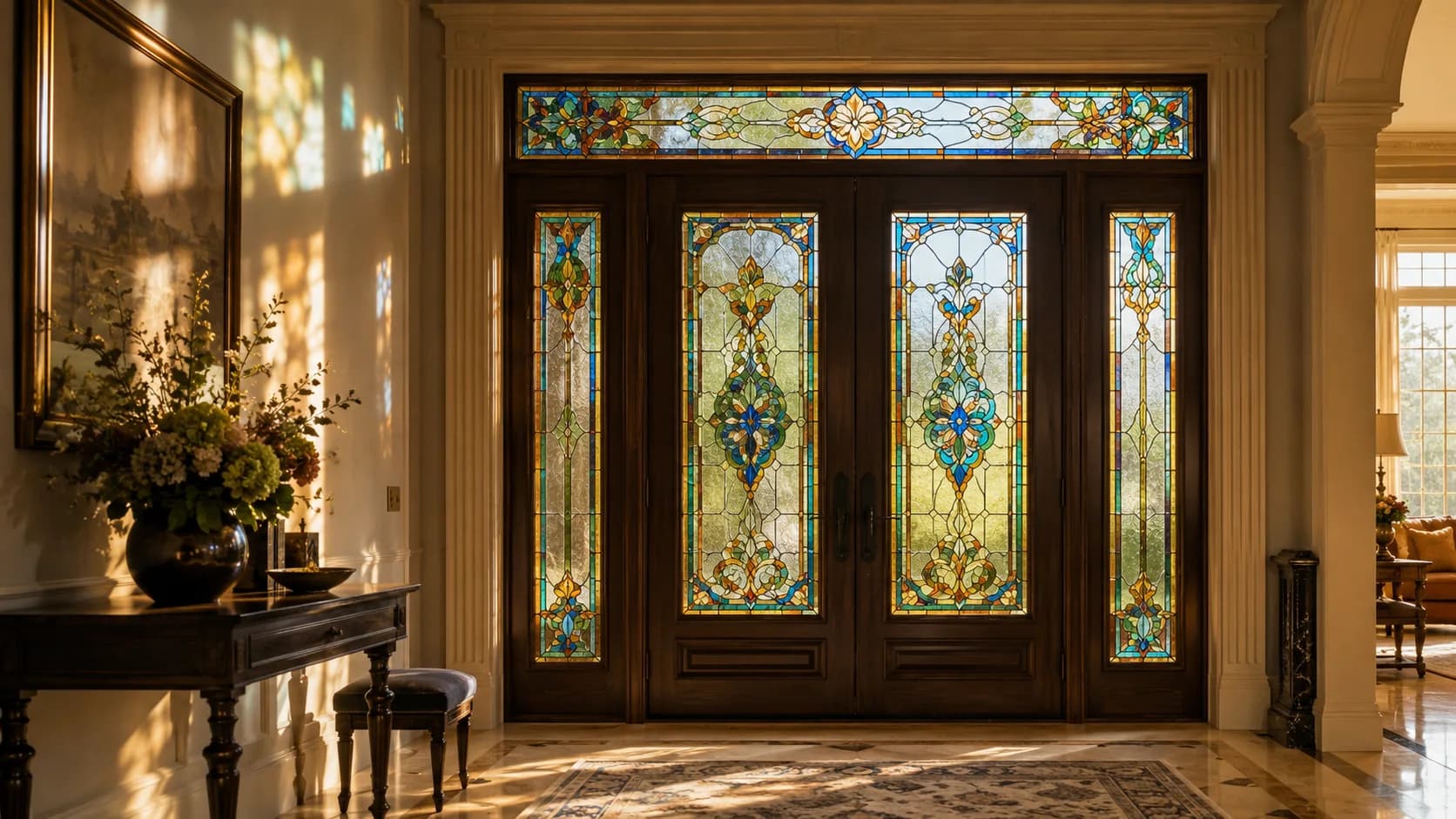
Residential stained glass can solve practical needs while becoming one of the most memorable features in a home. The best designs balance privacy, natural light, architecture, color and the way people actually move through the space.
Begin with the room’s purpose
A bathroom window has different needs than a front entry, stair landing, dining room or interior partition. Privacy, daylight, visibility from the street and nighttime appearance should all shape the design.
Good custom stained glass is not chosen from a generic pattern alone. It is designed for the opening and the experience of the room.
- Privacy level needed
- Direction of sunlight
- Viewing distance
- Interior finishes
- Street-facing appearance
Choose opacity before choosing color
Clear textured glass, opalescent glass, cathedral glass and beveled glass all filter light differently. The level of transparency affects comfort and function before color is even considered.
For privacy areas, texture and opacity often matter more than dark colors. A window can remain bright while limiting visibility.
- Textured clear glass for distortion
- Opalescent glass for privacy
- Beveled accents for sparkle
- Color accents for architectural harmony
Respect the home’s architecture
A Craftsman entry, Spanish-style residence, contemporary staircase and traditional dining room each call for a different design language. The stained glass should feel integrated rather than pasted onto the opening.
Proportions, leading lines, border width and color temperature can connect the new panel to doors, floors, hardware, tile and furniture.
- Door and window proportions
- Existing wood or metal tones
- Tile and stone colors
- Hardware finish
- Architectural period or style
Plan for safety and installation
Custom stained glass must be installed appropriately for the opening. Exterior exposure, door movement, building code requirements and protective layers may affect the final assembly.
A design conversation should include how the panel will be supported, protected and maintained—not only how it will look in a sketch.
- Door or fixed window installation
- Exterior versus interior exposure
- Support and frame details
- Cleaning and access
- Possible protective glazing
What to prepare before requesting a design
Photograph the opening from inside and outside, measure width and height, describe the privacy goal and share a few images of the surrounding room. A design direction becomes clearer when the architecture and light are visible.
If a homeowner has inspiration images, they can be useful for mood and preference, but the final stained glass should be developed for the specific opening.
- Opening dimensions
- Interior and exterior photos
- Privacy goals
- Preferred colors or materials
- Architecture and room photos
Yes. Textured and opalescent glass can limit visibility while still allowing natural light to pass through.
A custom design can be developed around the proportions, materials and character of the home rather than using a generic pattern.